Tuesday, 8 July 2014

Sydney Theodore Erby - Parramatta Soldier - WW1


Sydney Theodore Erby was born in 1895 at Parramatta. He was a son of George Thomas and Annie E Erby of Wigram St., Parramatta. He is a younger brother of Harold George Erby. He was driver with 4th Div. Train and 20th A.S.C. His service number was 8723. He served in France. He returned to Australia on 05 March 1919.

Monday, 7 July 2014

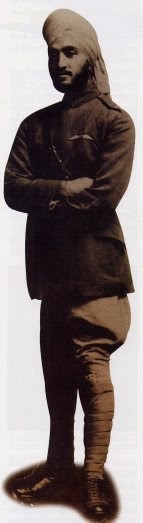
Hardit Singh Malik


Hardit Singh Malik was born on 22nd November 1894 and was the first Indian to fly into combat with the Royal Flying Corps.
Hardit was educated at a public school,Eastborne college and went on to Balliol College Oxford. Malik was a student at Oxford when the War broke out he decided to sign up for the Royal Flying Corps, like many of his fellow students. Initially he was denied a commission by the Royal Flying Corps and so intsead was forced to make an application to the French Air Corps instead, who accepted.

Malik's tutor at Oxford thought is absolutely scandalous that the Corps should refuse commission to a subject of the Empire while the French were willing to oblige. He took it upon himself to write to General Henderson, a friend and then head of the Royal Flying Corps, pleading Malik's case and as a result a Malik was offered a cadetship.
He reported to No.1 Armament School on 5th April 1917, and was commissioned into No.26 Squadron on 22nd June 1917. Malik's days with No.26 Squadron were relatively uneventful but once transferred to No.28 Squadron he saw plenty of action in the skies above Flanders. A specially designed helmet was worn by Hardit over his turban.

The following is an account from The colonial troops who fought the Allies' war, 1917 ... Indian pilot Hardit Singh Malik is guiding his single-seater biplane fighter up through thick cloud behind his renowned Canadian flight commander, William 'Billy' Barker, in search of enemy aircraft.
Their dangerously blind ascent finally ends as they emerge into clear blue sky -- and into a formation of German planes, which immediately start firing. Malik's plane is hit, and pain rips through his right leg.

Amazingly both Barker and Malik survived to tell their stories, a testament to both their courage and skill. As the first Indian to fly into combat with Britain's Royal Flying Corps, Oxford-educated Malik was a trailblazer and was the only Indian aviator to survive the First World War.
 
After the war he joined the Indian Civil Service and later the Indian Foreign Service and eventually served as Indian Ambassador to France. For the rest of his life Malik proudly carried the remnants of the bullets firmly embedded in his leg and lived till he was 91.

Tuesday, 24 June 2014

WW1 - DARWAN SINGH NEGI

Darwan Singh Negi


Darwan Singh Negi was born in November 1881.  Darwan Singh Negi was among the earliest Indian recipients of the highest and most prestigious award  - Victoria Cross.

He was approximately 33 years old, and a Naik in the 1st Battalion, 39th Garhwal Rifles, British Indian Army during the First World War when the following deed took place for which he was awarded the VC, the citation was published in a supplement to the London Gazette of 4 December 1914 (dated 7 December 1914), and read:

War Office, 7th December, 1914.
His Majesty the KING-EMPEROR has been graciously pleased to approve of the grant of the Victoria Cross to the undermentioned soldiers of the Indian Army for conspicuous bravery whilst serving with the Indian Army Corps, British Expeditionary Force: —
1909, Naik Darwan Sing Negi, 1st Battalion, 39th Garhwal Rifles.

For great gallantry on the night of the 23rd-24th November, near Festubert, France, when the regiment was engaged in retaking and clearing the enemy out of our trenches, and, although wounded in two places in the head, and also in the arm, being one of the first to push round each successive traverse, in the face of severe fire from bombs and rifles at the closest range.

He retired at the rank of Subedar. His Victoria Cross is held by his family.  Darwan Singh Negi died on 24 June 1950.


Thursday, 19 June 2014

Parramatta Flying Dentist - William Ewart Hart


William Ewart Hart (1885 – 1943)

Born

20 April 1885

Parramatta, Sydney

Died

29 July 1943

Parramatta, Sydney

Occupation

·         Dentist (1906 – 1943)

·         Aviator (1911 – 1912)

·         Air Force Officer (1916 – 1916)


William Ewart Hart was born on 20th April 1885 at Parramatta. He was known as “Billy”. Billy’s father William Hart, a timber merchant was born in Parramatta on 1st December 1855. His mother Maria Alice was also born in Parramatta in 1862. William and Maria got married in Parramatta in 1880. William Ewart Hart was their third child.  

William Ewart Hart started his career as a dentist and became the first “qualified” Australian pilot. He was awarded Australian aviator’s licence No. 1 on 5th December 1911.

William Hart was apprenticed at 16 to a dentist and was registered as dentist on 26th June 1906. He practiced at Newcastle and Sydney.

William Ewart Hart was interested in aviation. He bought Bristol Box-kite aircraft for £1333 from Joseph Hammond, who was touring Australia as a demonstration pilot for the British & Colonial Aeroplane Co. Ltd.  He received few flying lessons from Hammond’s mechanic. His first record flight was on 4th November 1911 from Penrith to Parramatta Park - a distance of about 29km. He flew a Bristol Box-kite aircraft. This flight took 19 minutes and his aircraft reached an altitude of 3000 feet. The field where Hart landed in Parramatta Park remains to this day much as it was in 1911.

He was a winner of Australia’s first air race from Botany to Parramatta in 1912 - a distance of 32km. He completed the distance in 23 minutes and won the race.

In 1912, William Ewart Hart opened Aviation School in Penrith, taking on student aviators.  In August 1912, he constructed a two-seat monoplane which he successfully tested at Wagga Wagga, but wrecked it in a serious accident at Richmond on 4 September 1912. He was badly injured and never flew again. He resumed his previous occupation of dentist.


In January 1916, William Ewart Hart was enlisted in the Australian Imperial Force, and as a lieutenant in No.1 Squadron, Australian Flying Corps. He went to Egypt and Britain as an instructor. He was found medically unfit and returned to Australia.  He was discharged from duties on 11 September 1916.

William Ewart Hart got married to Thelma Claire Cock on 10th August 1929 in Parramatta. They lived at Cheltenham. In the 1930s he visited Britain and the United States of America where he observed the latest developments in dentistry. He introduced new dental theories after his return to Australia.

 
William Ewart Hart died on 29th July 1943 from heart disease. He was cremated in Rockwood Crematorium on 31st July 1943 with Methodist forms as the RAAF flew overhead in salute. Air Force Association in its minutes recorded that he was a “respectful, courageous pioneer, soldier, airman, loyal friend and good citizen, lovable personality and gallant gentleman”.

A memorial to William Ewart Hart was unveiled in Parramatta Park in 1963.


Friday, 23 May 2014

EMMA ORCZY - WW1

Emma Orczy - How World War 1 affected women


A lot of women took new jobs in war industries because the pay was better, and the work more interesting, than what was open to them before (though the work was often hard and exhausting). It was also a way to support the war effort and indirectly support men they knew who were fighting.

Emma Orczy, the daughter of the composer, Baron Felix Orczy, was born in Hungary in 1865. Educated in Brussels and Paris, Orczy moved to London in 1880 to study art.

While in England Orczy met and married the English artist, Montague Barstow. In 1905 Orczy published her first novel, The Scarlet Pimpernel. The book was a great success but the numerous sequels such as I Will Repay (1906) and the Elusive Pimpernel (1908) sold poorly. Orczy also wrote detective fiction including The Old Man in the Corner (1909) and Lady Molly of Scotland Yard (1910).

During the First World War Orczy was actively involved in the Order of the White Feather, an organisation that encouraged women to give out white feathers to young men who had not joined the British Army.

After the Armistice Orczy moved to Monte Carlo where she continued to write novels and an autobiography, Links in the Chain of Life.

Emma Orczy died in 1947.

Tuesday, 20 May 2014

Financial Cost of the First World War


Allied Powers
Cost in Dollars in 1914-18
United States
22,625,253,000
Great Britain
35,334,012,000
France
24,265,583,000
Russia
22,293,950,000
Italy
12,413,998,000
Belgium
1,154,468,000
Romania
1,600,000,000
Japan
40,000,000
Serbia
399,400,000
Greece
270,000,000
Canada
1,665,576,000
Australia
1,423,208,000
New Zealand
378,750,000
India
601,279,000
South Africa
300,000,000
British Colonies
125,000,000
Others
500,000,000
Total of all Costs
125,690,477,000

Friday, 16 May 2014

MURRAY BROTHERS - Part 2


In 1889 Murray Brothers erected Parramatta’s first shopping emporium on the corner of Church and Macquarie Streets at a cost of 10,000 pounds which supplied all trades.  Household items were also sold i.e. furniture and furnishing, crockery, pianos, organs, clothes and jams. In 1890s Murray Brothers received a Certificate of Merit for colonial made furniture by Royal Agriculture Society.

During 1903 Murray Brothers was divided into two companies, Murray Brothers Ltd. and Murrays Limited, maintaining separate but adjacent businesses.  Drapery and furniture was under the control of Murray Brothers and the hardware section under the control of Murrays Limited.  W. R. Murray became sole proprietor of Murray Brothers.  The plumbing section was taken over by T. H. Harvey and E. N. Murray and became Harvey and Sons Pty. Ltd.

During the Second World War Murray Brothers donated 1000 pounds to the war effort. 

A new store was built on the north west corner of Church and Macquarie Streets after the National School was demolished in c1924.  Murray Brothers acquired extra property in August 1958 at the rear and a four storey building was erected with a Marsden Street frontage.  Fire guttered the furniture factory at the rear of the store damaging stores of furniture and expensive cabinet making machinery. Damage bill running into many thousands of pounds.
In 1947, Murray Brothers manufactured their last consignment of Blind and Curtain.  Also that year the business was purchased by Burns Philp and Co. Ltd.

1st May 1954, Murray Brothers purchased the site from the Church of England for 250,000 pounds.  A store was built on the site while the land was still under the lease from the church.

Murray Brothers expanded to become Parramatta’s oldest and highly respected departmental store with the policy of supplying the needs of residents in and around Parramatta. Murray Brothers closed their doors in 1978 after 102 years of trading in Parramatta.  They stayed in the Parramatta location not spreading their wings into other suburbs.

References:
  • T Kass, C Liston and John McClymont, Parramatta: A Past Revealed, Parramatta City Council, Parramatta, 1996

  • Murray Brothers, Vertical File, Local Studies and Family History Library, Parramatta Heritage and Visitor Information Centre

  • Photos from , Local Studies and Family History Library, Parramatta Heritage and Visitor Information Centre