Thursday, 5 March 2015

WW1 - Sydney Theodore Erby


Sydney Theodore Erby was born in 1895 at Parramatta. He was a son of George Thomas and Annie E Erby of Wigram St., Parramatta. He is a younger brother of Harold George Erby. He was driver with 4th Div. Train and 20th A.S.C. His service number was 8723. He served in France. He returned to Australia on 05 March 1919.

Monday, 2 March 2015

WW1 - Russian Revolution - March 1917


The First World War had cost Russia millions of lives. Those not actually fighting had to face serious food shortages. The winter of 1916-17 was very cold and fuel was in very short supply. Cold and lack of food create an environment that lead to trouble for those blamed for these problems.
By March 1917, discontent came to a head in Petrograd -this was St. Petersburg but the name sounded too German so in 1914 the name was changed to the more Russian sounding Petrograd. Petrograd became St. Petersburg.
March 4th - workers in the city’s largest factory (the Putilov engineering factory) demanded a 50% wage increase so that they could buy food. The management refused so the workers went on strike.
March 8th - 30,000 workers were locked out of work. They were not paid and could not afford any food now. The strikers persuaded other workers to come out on strike. Demonstrations occurred throughout the city. Nicholas II was in Petrograd at this time but he left to inspect troops at the war front thinking that the demonstrations were the work of hooligans and that they would end shortly. He was very wrong.
March 9th - the riots got worse and were getting out of hand. Nicholas was informed about the situation and the Russian Parliament (the Duma) pleaded with him to order the release of emergency food supplies. He refused and ordered that the riots should be put down by March 10th 1917.
March 10th - the police tried to carry out the orders of Nicholas. Unfortunately, people got killed and the rioters became even angrier. The rioters opened up prisons and released those in them. For the first time there were calls for the tsar to quit. The head of the Duma informed Nicholas that law and order had broken down as soldiers brought in to put down the rioters had, in fact, joined them. Nicholas then did something very foolish. He ordered that the Duma was no longer to meet.
March 11th - the Duma disobeyed Nicholas - this is usually considered the first act of the Russian Revolution. The members of the Duma met in chaos. One person in the Duma, Alexander Kerensky, shouted out that 25,000 soldiers had mutinied and were marching to where the Duma was meeting to support them. With this support, the Duma decided to form a temporary government (the Provisional Government) to take the place of the tsar. In a bizarre move, Alexandra, the tsar’s wife, phoned him to tell him that he had nothing to worry about.
March 12th - The leader of the Duma was a man called Rodzianko. He persuaded Nicholas that things had got very bad for the royal family. Nicholas then decided to return to Petrograd to restore law and order. The Provisional Government by this time had got some degree of control and they stopped the royal train outside of Petrograd. The government wanted to talk terms with Nicholas. The first plan was for Alexis - the son - to take over but Nicholas refused this as he felt that the boy was too weak. The throne was offered to Grand Duke Michael but he did not want it. It became clear to Nicholas that the Provisional Government did not want a tsar and he was forced to give up the throne.
Royalty came to an end in Russia in March 1917.

Sunday, 1 March 2015

The Neuve Chapelle Memorial


  Photo: Commonwealth War Graves Commission
The Neuve-Chapelle Indian Memorial is a World War I memorial in France, located on the outskirts of the commune of Neuve-Chapelle, in the department of Pas de Calais. The memorial commemorates more than 4700 Indian soldiers with no known grave, who fell in battle while fighting for the British Indian Army in the First World War. The location of the memorial was chosen because of the participation by Indian troops at the Battle of  Neuve-Chapelle.

The memorial was designed to honour India, its culture and traditions. The memorial is a circular enclosure centred on a tall pillar that is topped by a lotus capital, and carved representations of the Star of India and the Imperial Crown. Two tigers are carved on either side of the column guarding the temple of the dead. On the lower part of the column the words ‘God is One, He is the Victory’ are inscribed in English, with similar texts in Arabic, Hindi, and Gurmukhi.
It bears the following inscription:
English: To the honour of the Army of India which fought in France and Belgium, 1914-1918, and in perpetual remembrance of those of their dead whose names are here recorded and who have no known grave.
French: En honneur de l'Armee de l'Inde qui a combattu en France et en Belgique 1914-1918, et pour perpetuer le souvenir de ses morts aux tombes inconnues dont les noms sont ici graves.
Photo: Commonwealth War Graves Commission
The memorial at Neuve Chapelle was designed by Sir Herbert Baker and sculpture by Charles Wheeler. The memorial was unveiled by Earl of Birkenhead on 7th October 1927. Lord Birkenhead, then Secretary of State for India, had served as a staff officer with the Indian Corps during the war. The ceremony was also attended by the Maharaja of Karputhala, Marshal Ferdinand Foch, Rudyard Kipling, and a large contingent of Indian veterans.
Gabar Singh Negi, a Victoria Cross recipient is also commemorated on the Neuve-Chapelle Memorial. There are 4703 names inscribed on the memorial. Many of the men lost their lives during the Battle of Neuve Chapelle in March, 1915.
A commemorative book was published at the time, with a foreword written by King George V
Photo: Commonwealth War Graves Commission
 

Thursday, 12 February 2015

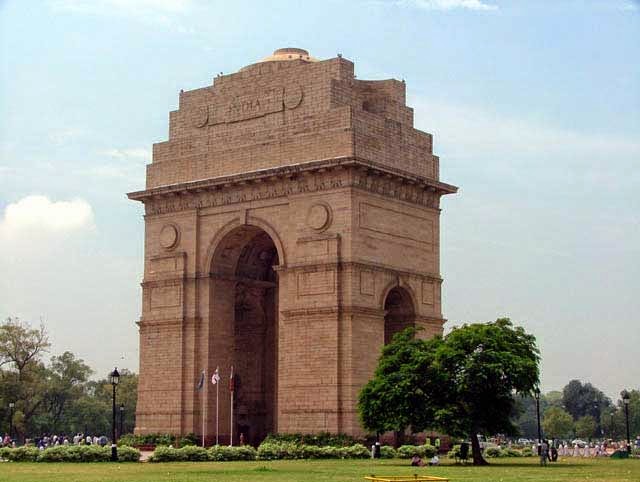
The Delhi Memorial – India Gate


The Delhi Memorial, also known as India Gate, stands at the eastern end of Rajpath or Kingsway. It is situated in the heart of New Delhi. India Gate was designed by Sir Edwin Lutyens and unveiled by Lord Irwin on 12th February 1931.

It was named “All India War Memorial” but later changed the name to India Gate. Indian Gate commemorates the soldiers of Indian Army who lost their lives while fighting as British allies in the First World War and the Third Anglo-Afghan War.

13,300 Commonwealth servicemen are commemorated by name. The Delhi Memorial also acts as a national memorial to all the 70,000 soldiers of Undivided India who served and died during the First World War. 

Burning in a shrine under the arch of India Gate since 1971 is the Amar Jawan Jyoti (the flame of the immortal soldier) which marks the Tomb of the Unknown Soldier.

Wednesday, 4 February 2015

WW1 - Deaths of Indians in Brighton Hospitals


Over one and a half million Indian army soldiers served alongside British troops during the World War One. Twelve thousand Indian soldiers who were wounded on the Western Front were hospitalised at sites around Brighton. These included York Place School, the Dome, the Corn Exchange and the Royal Pavilion.
The fifty-three Hindu and Sikh soldiers who died in Brighton were taken to a peaceful resting place on the Sussex Downs near Patcham for cremation, after which their ashes were scattered in the sea, in accordance with their religious rites.

The Muslim brothers in arms, totalling nineteen, were buried in a purpose built burial ground near to the Shah Jehan Mosque in Woking. Built in 1889, the mosque is the oldest of its kind in north-west Europe.
Deaths of Indians in Brighton Hospitals:

Kitchener Hospital:
36 deaths -  25 Hindus/Sikhs cremated at Patcham; 11 Mohammedans buried at Woking.

Royal Pavilion:
18 deaths - 10 cremated at Patcham; eight buried at Woking.

York Place Hospital:
20 deaths - 18 cremated at Patcham; 2 buried at Woking.

Total cremated on the Downs at Patcham
53
Total buried at Jehan Mosque in Woking
21
Total deaths
74

The Gurkha Memorial


On 3rd December 1997, British memorial to the Gurkhas was uneviled in London by HM The Queen, on Horse Guards Avenue.
 
Photo: Commonwealth War Graves Commission

The inscription is a quotation from Sir Ralph Turner, a former officer in the 3rd Gurkha Rifles.

THE GURKHA SOLDIER
Bravest of the brave,
most generous of the generous,
never had country
more faithful friends
than you.

Sunday, 1 February 2015

Indian soldiers and food during WW1


Sheep being taken ashore at Gallipoli in 1915, to be issued live to the Indian troops for slaughter according to their religious practices. [AWM C01662]


WW1 – What did Indian soldiers eat during WW1
·         1⁄4 pound meat
(Non-meat eaters received 2 ounces of gur (coarse, unrefined sugar made from sugar cane juice) or sugar or 3 ounces of milk in place of 4 ounces of meat)
·         1⁄8 pound potatoes
·         1⁄3 ounce tea
·         1⁄2 ounce salt
·         1 1⁄2 pounds atta (flour)
·         4 ounces dhal (dried lentils, peas or beans which have been stripped of their outer hulls and split)
·         2 ounces ghee (clarified butter)
·         1⁄6 ounce chillies
·         1⁄6 ounce turmeric
·         1⁄3 ounce ginger
·         1⁄6 ounce garlic
·         1 ounce gur

Indian troops' iron rations (emergency supplies issued in case soldiers were cut off from regular rations) consisted of:
·         1 pound biscuit
·         8 ounces gur
·         1 ounce tea
·         6 ounces condensed milk or 21⁄2 ounces dried milk in lieu, when available.